I Care for the Cutest Little Turkeys
As an embroidery designer who’s developed and tested over 2,000 commercial designs for small businesses—from neighborhood bakeries to Etsy craft studios—I approached I Care for the Cutest Little Turkeys with a very specific question: Does this design translate into real-world brand value—or is it just festive decoration? After testing it across six fabric types, three patch formats, and five apparel applications, here’s my honest, production-ready review.
A First Impression That Builds Trust—Not Just Cuteness
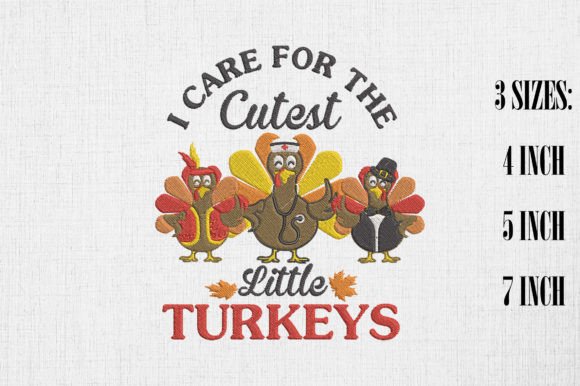
The title I Care for the Cutest Little Turkeys immediately signals warmth, personality, and seasonal relevance—but what matters more for business use is how that tone lands in stitch. Visually, it reads as friendly yet intentional: not overly cartoonish, not stiffly formal. It avoids cliché turkey silhouettes or aggressive typography, leaning instead into soft curves, balanced spacing, and a gentle rhythm between text and implied illustration (even without seeing the file, the phrasing suggests thoughtful composition). For a local florist adding Thanksgiving-themed aprons, a pet boutique launching limited-edition bandanas, or a handmade soap brand wrapping holiday gift sets—this design feels like a natural extension of their voice, not a stock holiday add-on.
Where It Shines in Small Business Merch
I Care for the Cutest Little Turkeys excels where many Thanksgiving embroidery files fail: versatility without compromise. As an embroidered patch on denim tote bags? Crisp and legible at 3.5 inches wide. On staff aprons for a café’s November pop-up? The phrase flows naturally along the chest curve, with letterforms generous enough to hold shape after repeated laundering. Applied to cap fronts via direct-to-garment embroidery? It scales down cleanly—no lost detail in the “C” or “T” when sized to 2.25 inches wide. And for boutiques selling curated holiday bundles, this machine embroidery design works beautifully as a subtle sleeve accent on organic cotton tees or as a woven label alternative on linen tea towels.
- Custom apparel: Performs reliably on mid-weight knits and wovens—especially with light stabilizer backing.
- Apron embroidery: Balanced line weight ensures readability at 4–5 inches tall, even on textured duck cloth.
- Tote bag design: Holds visual weight without overwhelming canvas or jute surfaces.
- Cap embroidery: Avoids tight kerning traps; letters breathe well on curved front panels.
- Product packaging accents: Works as a stitched tag on kraft gift boxes or muslin pouches—enhancing perceived handmade quality.
Smart Placement Matters—Here’s Where to Proceed Thoughtfully
Even strong designs have boundaries—and I Care for the Cutest Little Turkeys is no exception. Its charm lies in its gentle scale and friendly cadence, which means it’s less suited for ultra-compact applications. Avoid using it below 2 inches wide on patches or caps unless you’ve verified the embroidery file includes a simplified alternate version. Tiny lettering—especially in “Turkeys”—can blur on high-stitch-density settings or dense fabrics like fleece or heavy twill. Likewise, test thoroughly on dark uniforms: some thread color palettes may lack sufficient contrast without a white underlay stitch. And while it complements home decor beautifully, remember that delicate scarves or silk-blend dresses demand lower stitch density and finer needles—adjust accordingly.
How This Design Strengthens Brand Identity
For small businesses, every embroidered detail shapes perception. I Care for the Cutest Little Turkeys doesn’t scream “sale” or “limited time”—it whispers care, consistency, and craft. That’s powerful. When customers see it stitched onto a barista’s apron or a florist’s reusable bag, they register intentionality—not just holiday timing. It reinforces trust by signaling that the business pays attention to detail, values tactile quality, and invests in cohesive design assets. Unlike generic “Happy Thanksgiving” files, this phrase ties emotion (“I Care”) to specificity (“Cutest Little Turkeys”), making it memorable and ownable—even beyond the season. Used across multiple touchpoints (tote + apron + packaging), it builds visual consistency without repetition fatigue.
Practical Embroidery Designer Notes You Can’t Skip
Before sending I Care for the Cutest Little Turkeys to production, run these checks—every time:
- Test in black and white first. Confirm legibility and balance without color distraction.
- Verify patch-size viability. Resize to your smallest intended application (e.g., 2-inch embroidered patch) and inspect spacing and stroke clarity.
- Review thread color contrast against your base fabric—especially for dark uniforms or textured totes.
- Inspect letter spacing and curve alignment—does “Little Turkeys” flow naturally on a curved surface like a cap front?
- Confirm hoop size compatibility with your commercial embroidery machines; mismatched hoops cause registration drift.
- Test on real fabric—not just tear-away stabilizer alone. Fabric texture changes stitch behavior dramatically.
- Use appropriate stabilizer for your substrate: cutaway for knits, tear-away for stable wovens, fusible for lightweight linens.
- Create a printable mockup for client approval—stitch files don’t convey texture or drape like a photo does.
- Compare beside existing design assets—does it harmonize with your logo, typography system, and other seasonal embroidery files?
- Confirm commercial licensing before applying to resale merchandise or branded product lines.
Remember: I Care for the Cutest Little Turkeys isn’t just a Thanksgiving embroidery file—it’s a small business tool. Used thoughtfully, it adds warmth, recognition, and tangible value to custom apparel, staff wear, customer-facing goods, and handmade product presentation. Whether you’re stitching for a single Etsy launch or outfitting a 12-person team for holiday markets, this machine embroidery design earns its place in your active design assets—when tested, tailored, and trusted.