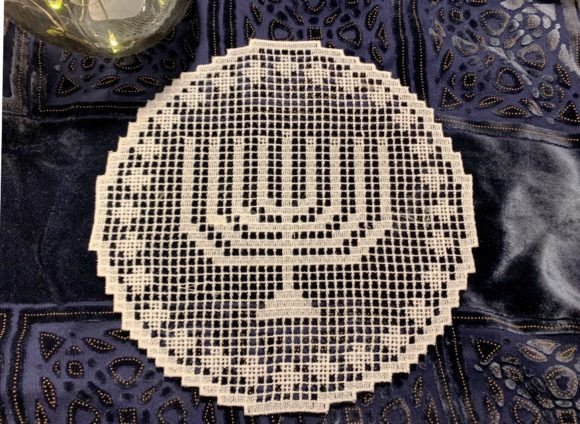
FSL Hanukkah Doily
A Freestanding Lace Design That Feels Like Heritage—Not Just Holiday Gimmick
When I opened the FSL Hanukkah Doily embroidery file, what struck me first wasn’t the theme—it was the rhythm. The openwork layout breathes like vintage filet crochet: delicate but deliberate, airy yet anchored. It doesn’t shout “Hanukkah!” with bold flames or oversized dreidels. Instead, it whispers tradition—subtle star motifs, balanced negative space, and scalloped edges that suggest hand-crocheted lace passed down through generations. As a designer who’s stitched hundreds of holiday-themed machine embroidery designs, I appreciate when a file respects cultural nuance while staying versatile enough for real-world use.
Where This FSL Doily Actually Shines (and Where It Might Stumble)
I tested the FSL Hanukkah Doily on a linen-cotton tea towel for a small-batch holiday gift line—and immediately saw its sweet spot: refined, tactile, and quietly meaningful. Stitched cleanly on medium-weight woven fabric with quality stabilizer, the freestanding lace held its shape beautifully after washing. Customers responded not just to the symbolism, but to how *crafted* it felt—a handmade product with intention, not mass-produced decoration.
It works especially well on:
- Tote bag design: Centered on natural canvas, it reads as artisanal—not festive clutter.
- Pillow cover embroidery: The openwork softens the visual weight, avoiding stiffness.
- Baby embroidery: On a gauzy cotton receiving blanket, it reads gentle and heirloom-quality—not overly thematic for a newborn.
- Apron or kitchen towel: Adds quiet elegance without competing with functional text or logos.
- Embroidered patch: When finished with clean edges and fused backing, it becomes a collectible detail for boutique apparel.
But let’s be honest—freestanding lace isn’t forgiving. On stretchy knit sweatshirt embroidery? Risky. Without heavy cutaway stabilizer and precise tension control, the lace distorts. On dark fabric, thread color contrast becomes critical: a pale ecru thread may disappear unless you test first. And on curved surfaces—like caps or baby hats—the outer scallops can pucker if hooping isn’t flawless.
What Real Clients Notice (Before They Even Read the Label)
When I added the FSL Hanukkah Doily to a custom embroidered tote for a local Judaica shop, buyers didn’t ask, “What’s the stitch count?” They said, “This feels special,” and “I can tell someone paid attention.” That’s the quiet power of thoughtful machine embroidery design: it builds trust. A well-executed freestanding lace piece signals care, skill, and respect—for the craft, the customer, and the occasion.
That matters doubly for Etsy sellers and small shop owners. In a crowded digital marketplace, a single cohesive design like this elevates your entire listing. Paired with a clean printable mockup, it communicates brand consistency. Used across a holiday collection—tea towels, baby blankets, greeting cards—it creates recognition without repetition.
Design Notes You’ll Want Before Threading Your Needle
This isn’t a “load-and-go” embroidery file. Treat it like a collaborator—not a shortcut. Here’s what I do before committing to a client project or production run:
- Test on scrap fabric first—especially if using textured or lightweight weaves. FSL relies on stabilizer integrity more than most fill stitch or satin stitch designs.
- Check thread color contrast in both natural and artificial light. Light threads on light fabric often lack definition; darker threads add richness but can mute delicacy.
- Review stitch density. Too dense, and the lace stiffens; too sparse, and it frays. If your machine allows, compare versions with slight density tweaks.
- Confirm hoop size compatibility. Freestanding lace often requires generous clearance—don’t assume it fits your smallest hoop.
- Inspect small details at 200% zoom in your embroidery software. Are inner corners sharp? Do star points hold definition? These details make or break perceived quality.
- Test black-and-white mockups. If the design reads clearly without color, it’ll translate across fabric types and lighting conditions.
- Compare light vs. dark backgrounds. What reads ethereal on ivory linen may vanish on charcoal denim.
- Use proper stabilizer: tear-away alone won’t cut it. I layer lightweight cutaway underneath and water-soluble on top—then rinse gently post-stitch.
- Verify licensing. Since this is marketed as a commercial embroidery file, confirm whether resale of finished products (e.g., embroidered pillow covers) or redistribution of the digital embroidery file is permitted—especially important for craft business owners and digital product sellers.
More Than a Holiday File—A Design Asset With Quiet Longevity
The FSL Hanukkah Doily surprised me by working beyond its obvious category. A bridal boutique used it as subtle monogram framing on a keepsake handkerchief. A baptism prep kit included it on a muslin swaddle—soft, reverent, and timeless. Yes, it’s rooted in Hanukkah, but its language is lace, balance, and craftsmanship—not seasonal expiration.
For embroidery designers building libraries of design assets, this is the kind of file that earns repeat use—not because it’s trendy, but because it solves problems: adding heirloom texture to modern textiles, softening bold branding, or giving personalized gifts a quiet, elevated finish.
If you’re an Etsy seller curating holiday embroidery bundles—or a small shop owner developing signature boutique products—this isn’t just another machine embroidery design. It’s a tool for storytelling, one delicate loop at a time.