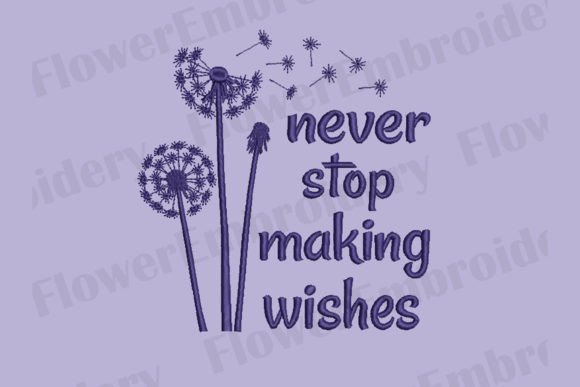
Never Stop Making Wishes
A Craft Fair Designer’s First Look at This Inspirational Embroidery Design
As someone who’s stitched over 300 craft fair booths—and curated embroidery for handmade markets from Portland to Nashville—I opened Never Stop Making Wishes expecting something gentle, hopeful, and quietly confident. What I found was exactly that: a dainty yet purposeful machine embroidery design that lands somewhere between modern minimalism and heartfelt charm. It doesn’t shout—it smiles. And in a crowded booth where bold fonts and glittery motifs compete for attention, that quiet sincerity is pure gold.
Where It Shines: Real-World Craft Fair Product Pairings
Never Stop Making Wishes isn’t just a phrase—it’s a mood anchor. That makes it incredibly versatile across handmade product categories:
- Tote bag design: Centered on the front of a natural canvas or oat linen tote, it reads clearly from six feet away—soft enough for moms, refined enough for boutique shoppers.
- Apron embroidery: Positioned above the pocket on a denim or chambray apron, it adds personality without overwhelming function. Customers love stitching that feels personal but not precious.
- Tea towel embroidery: Works beautifully on medium-weight cotton towels—especially when paired with subtle thread colors like heather gray, dusty rose, or soft sage. Avoid overly textured terry cloth; smooth weaves hold the daintiness best.
- Embroidered patch: A standout option. When heat-applied or sewn onto denim jackets or market bags, Never Stop Making Wishes becomes an instant conversation starter—hopeful, wearable, and giftable.
- Fabric pouches & pillow covers: Its balanced proportions scale well down to 3–4 inches. On a linen pouch or velvet pillow, it reads as intentional, not incidental.
- Caps & curved surfaces: Proceed with caution. The lettering and delicate line work may distort on structured caps unless digitized with curve compensation. Test first on scrap fabric with similar tension and curvature.
What Makes It Sell—And What Demands Extra Care
This is where experience matters. As an embroidery designer reviewing Never Stop Making Wishes for weekend market readiness, I ask: Does it convert? Does it photograph well? Can I batch-produce it without second-guessing every hoop?
Yes—to all three—but only with thoughtful execution. The phrase has strong visual rhythm: short words, open spacing, and no tight kerning traps. That means fewer read-aloud stumbles at the booth (“Wait—is that ‘Wishes’ or ‘Wishers’?”). It also photographs cleanly for Etsy listings and printable mockups, especially against light neutral backgrounds.
However, “dainty” comes with caveats. Tiny details—like fine serifs or narrow connecting strokes—can vanish on dark fabric or thick stabilizer. If you’re stitching on charcoal twill or black canvas, use high-contrast thread (e.g., bright white or metallic silver) and double-check stitch density in the file. Overly dense areas may pucker thin fabrics; too-light density may fray on textured tea towels.
Design Notes Every Handmade Seller Should Know
Before cutting your first production run, do these five things:
- Test the embroidery file on scrap fabric matching your final product—same weight, same weave, same pre-wash status.
- Check thread contrast under both natural and booth lighting. What looks crisp in daylight may blur under warm string lights.
- Review spacing and letter height. Does “Never Stop” sit comfortably above “Making Wishes”? Uneven baseline alignment kills premium perception.
- Confirm hoop size compatibility with your machine and intended product. A large hoop may not fit on a small pouch—or may require re-hooping mid-stitch.
- Use the right stabilizer: lightweight cutaway for knits, tear-away for stable wovens, and fusible + tear-away combo for tea towels with texture.
Also—don’t skip the real mockup. Stitch one finished product (a tote, a patch, a pillow cover) and hold it in your hand. Does it feel like a handmade product you’d proudly price at $38—not $22? Does it reinforce your brand voice? For many small shop owners, Never Stop Making Wishes elevates perceived value precisely because it avoids cliché. It’s not “Dream Big” or “Good Vibes Only.” It’s quieter, more personal—and that resonates deeply at handmade markets.
Booth Impact & Buyer Engagement
In my booth setup, I place Never Stop Making Wishes items near the front left corner—the “first glance zone.” Why? Because it draws people who respond to intentionality over intensity. They linger. They touch the fabric. They ask, “Is this yours?” That’s the moment a sale turns into a connection.
It also strengthens booth cohesion. Pair it with neutral-toned products and minimalist packaging, and suddenly your entire display whispers consistency—not clutter. As an Etsy seller or digital embroidery file creator, that same clarity translates directly to stronger listings: clean photos, focused copy, and repeatable design assets that customers recognize across your shop.
Final Thought: Hope Is a Handmade Product Too
Let’s be real: Not every inspirational embroidery design earns its keep at a craft fair. Some fade into background noise. Others feel forced or generic. Never Stop Making Wishes avoids both traps. It’s sincere without being saccharine, delicate without being fragile, and commercially viable without sacrificing artistry.
If you’re building a line of small shop products—or expanding your commercial embroidery offerings—this design earns its place. Just remember: its strength lies in thoughtful execution. Respect the daintiness. Honor the spacing. Test before you commit. And always, always stitch with the person holding your tote bag in mind—not just the machine running the file.
Because in the end, Never Stop Making Wishes isn’t just a phrase on fabric. It’s a promise you make—to your craft, your customers, and the quiet magic of showing up, stitch after careful stitch.