Christmas Owls: A Seasonal Embroidery Designer’s Real-World Review
First Impression: Festive, Delicate, and Distinctly Holiday-Ready
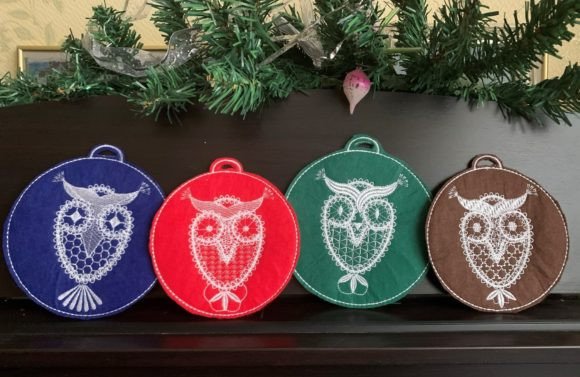
Opening the Christmas Owls embroidery file, I felt an immediate lift—this isn’t just another holiday motif. These owls carry a quiet, cozy elegance: soft curves, open lace-inspired negative space, and that unmistakable Battenberg lace rhythm. They’re not cartoonish or overly cutesy; instead, they whisper “heirloom charm” while still feeling fresh for 2024 shoppers. Each owl is centered in its own circle—a smart, self-contained composition that reads beautifully at multiple scales. That framing makes Christmas Owls instantly versatile: festive without shouting, detailed without overwhelming, and seasonal without leaning into cliché.
Where Christmas Owls Shines in Real Holiday Product Lines
I immediately pictured these on small-batch, gift-ready products where emotional resonance matters as much as execution. On lightweight cotton pillow covers? Yes—the circular layout anchors the design perfectly, and the lace-like openness prevents stiffness. On linen kitchen towels? Absolutely. The airy stitch structure breathes with the fabric, avoiding that heavy, plasticky look common in dense holiday embroidery. As embroidered patches for denim jackets or baby blankets? Ideal—each owl stands alone, so no awkward cropping or scaling needed.
Etsy sellers will love how Christmas Owls supports storytelling: “Hand-stitched charm meets vintage lace tradition” becomes tangible in product photos. For craft fairs, these designs translate cleanly into printable mockups—no complex layering required, just clean circles against warm neutrals or deep forest greens. And for family matching sets (think toddler tees + adult sweatshirts + coordinating totes), the consistent circular format creates instant visual harmony—even across different garment types and sizes.
They also elevate personalized gifts. Add a monogrammed initial *inside* the circle—or place the owl beside a custom name on a tea towel—and you’ve got warmth, intention, and craftsmanship in one stitch. Social media previews pop too: the contrast between solid fabric and delicate lace patterning catches the eye mid-scroll, especially against matte backdrops or natural wood textures.
Where to Use Christmas Owls Thoughtfully
Like any refined machine embroidery design, Christmas Owls rewards intentionality. Because it’s based on Battenberg lace, fine openwork is central—not filler stitching. That means caution is warranted on thick terry cloth (like heavy bath towels) or tightly woven dark fabrics where thread density may get lost. Metallic thread? Beautiful in theory, but test first: the delicate angles and narrow bridges in lace patterns can snag or break under metallic’s stiffness.
Stretchy knits—especially on curved surfaces like caps or raglan sleeves—need extra stabilization. The circular boundary helps, but don’t skip cutaway stabilizer and basting stitches. Also, avoid placing Christmas Owls in tiny hoop sizes (under 4" diameter) unless you’ve verified the smallest owl retains legibility. Those lace motifs rely on proportion—shrink too far, and the openwork collapses visually.
Seasonal Impact: Beyond Decoration, Into Emotional Connection
In holiday shopping, buyers don’t just buy owls—they buy nostalgia, calm, and quiet joy. Christmas Owls delivers that. It avoids overused symbols (reindeer, snowmen, Santa) while still reading unmistakably as *Christmas*. That differentiation builds trust: customers see thoughtfulness, not trend-chasing. For small shop owners, that translates to higher perceived value—and willingness to pay premium pricing for handmade gifts.
Brand consistency is easier too. Whether you use sage, cranberry, charcoal, or cream thread colors, the circular shape and lace rhythm keep your seasonal collection unified. No need to force matching fonts or borders—Christmas Owls carries its own visual signature. And because each owl is separate, you can rotate them across product categories without repeating the same image: one on a tote, another on a table runner, a third on an ornament—creating variety within cohesion.
Practical Designer Notes Before You Stitch
- Test thread colors on both light and dark fabric—lace-based designs shift dramatically depending on contrast. What reads as delicate on ivory may vanish on navy unless you adjust top thread weight or add underlay.
- Confirm stitch density before production. Battenberg-inspired work often balances fill and open space—verify that density won’t cause puckering on lightweight cotton or shifting on slippery satin.
- Match hoop size to intended product. Since each owl is “in a circle,” choose the largest version that fits your target hoop—and double-check clearance for seam allowances on pillow covers or aprons.
- Use appropriate stabilizer: medium-weight cutaway for stable wovens (towels, linens), tear-away + topping for knits or nap fabrics (like velvet ornaments).
- Create realistic mockups—not just flat PNGs. Show how the lace pattern interacts with fabric texture, drape, and light. Customers buying digital embroidery files or finished products want to *feel* the result.
- Review small details after stitching: check for stray thread ends near lace bridges, ensure no skipped stitches in narrow arches, and confirm smooth transitions where circle meets fabric edge.
- Plan cohesive color palettes across your seasonal line—pair Christmas Owls with supporting solids or tonal prints that let the lace breathe.
- Confirm commercial licensing terms before selling finished seasonal products. This is essential for Etsy sellers, wholesale partners, or anyone producing physical goods with the Christmas Owls embroidery file.
Final Thought: A Timeless Addition to Your Holiday Line
Christmas Owls isn’t just another holiday embroidery file—it’s a thoughtful, market-smart tool for creators who value both aesthetic integrity and real-world performance. It works quietly but powerfully across sweatshirt embroidery, kitchen towel design, pillow cover accents, and embroidered patch collections. When stitched well, it transforms everyday items into cherished handmade gifts—calm, distinctive, and deeply seasonal. For embroidery sellers building limited-edition drops or expanding their small shop product range, this is the kind of seasonal embroidery that earns repeat customers, social shares, and heartfelt notes from buyers who say, “It feels like Christmas—without the noise.”